
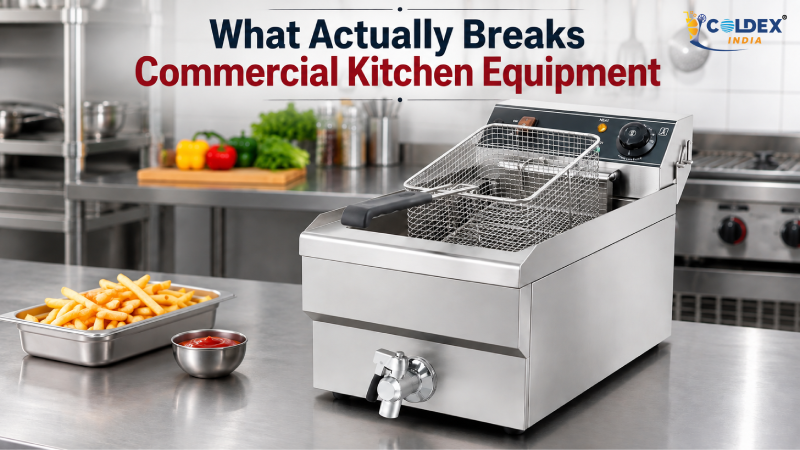
Machines built for commercial service are built to run all day. When one dies at two years instead of ten, the cause is almost never the machine. It is a handful of habits, and they are the same handful in almost every kitchen.
None of what follows takes long. The daily part is about fifteen minutes at close, and it is the difference between a service call and a quiet year.
The three things that do most of the damage
Heat with nowhere to go
Every machine that makes heat has to lose it, and every machine that makes cold has to throw heat away. Push either into a tight corner and it runs hotter, works harder and fails sooner.
An ice machine shows this most clearly, because you can measure it. An air cooled unit in a hot, enclosed corner produces measurably less ice than the same machine with clear space around it, and it does so in exactly the weather when you need the most. The same principle applies to fryers, ovens and warmers: clearance behind and above is not a suggestion in the manual, it is what the rating assumed.
Steel on a non-stick coating
Non-stick coating is the working surface of a griller and a waffle machine, and it is the part that wears. It is what keeps cheese and butter from welding to the plate. Once it is scored, food sticks, the plate is scraped harder to clear it, and the damage accelerates.
Three rules keep it: scrape with a plastic tool and never with a knife or steel wool, clean while the plate is warm rather than hot or cold, and oil lightly before the first item of the day rather than mid-service. Treated that way the coating lasts for years. Attacked with a knife it will not see out the season.
Oil that was never changed
Oil in a deep fryer is a consumable, and how it is handled decides both the food and the machine. Old oil breaks down, smokes at a lower temperature, and leaves deposits that bake onto the element and the tank. Food fried in it is darker, greasier and tastes of everything fried before it.
Filtering daily and changing on a schedule rather than on appearance is the whole discipline. It also makes the case for a double tank unit clearer: two wells of 5.5 or 8 litres each are easier to manage than one large one when only one product is heavy on the oil.
The daily fifteen minutes
This is the routine that prevents most of the above. It is short by design, because a long routine is a routine nobody does.
- Fryers. Filter the oil while it is still warm and skim the debris. Debris left in the tank burns onto the element overnight.
- Grillers and waffle plates. Scrape warm with a plastic tool, wipe, and leave the lid open so the plates dry.
- Ovens. Wipe out spills before they carbonise. Baked-on sugar is far harder to remove on the second day than on the first, and it goes on burning every time the oven heats.
- Blenders. Half a jar of water at full speed for a few seconds, then rinse. Never run one dry: an empty jar at speed is what kills a seal.
- Warmers. Empty, wipe, and clean the glass. The glass is the part the customer looks at, so it is doing sales work as well as holding work.
- Mixers. Remove the attachment and wash it separately. Dough left to dry on a hook is significantly harder to remove and puts load on the motor at the next start.
The habits that shorten a machine's life
Running a machine above its rating
A planetary mixer rated for 3 kg of dough will turn 5 kg. It will do it today and it will do it next week, and the motor will be gone long before the machine looks worn. This is the most common way a mixer dies, and it is entirely invisible until it happens.
The kneading figure on a mixer is not a suggestion, it is the number the motor was built around. If you are regularly at or over it, the machine is the wrong size rather than the recipe being too large.
Loading cold into a holding machine
A warmer holds food at temperature; it does not bring it up to temperature. Loading cold food makes the unit run flat out for an hour trying to do a job it was not designed for, and the food still spends that hour in the range where it should not be.
Packing a cabinet solid
Air has to move around the trays in a warmer. Packed solid, the back of the cabinet runs cooler than the front, so half the food is not being held properly and the unit is working harder to achieve it.
Ignoring a small noise
A bearing that has started to complain, a fan that rattles, a door that no longer seals. Each is a small repair on the day it starts and a replacement machine three months later. Commercial equipment is chosen for parts availability precisely so that a fault is a repair, and that only holds if the fault is caught while it is still small.
One thing that is not neglect
Some wear is simply use, and non-stick coatings are the clearest example. A plate that has cooked a thousand sandwiches will not look new, and a coating that eventually needs replacing on a machine that has earned its keep is a consumable doing its job, not a failure. The distinction worth making is between wear that came from use and wear that came from a knife.