Two numbers decide a bakery. How many trays you need out of the oven in one cycle at your busiest hour, and how many kilos of dough you mix in one batch. Everything else on the equipment list follows from those, and almost every expensive mistake in a new bakery comes from guessing at them instead of working them out.
Work backwards from what you intend to sell on a Saturday morning, not from an average weekday. The shortfall on an undersized oven repeats every single bake, and it never gets smaller.
The oven, and the number that sizes it
A baking oven is sized on trays per bake. The standard tray here is 400 x 600 mm. Count how many you need out of the oven in one cycle, then choose the deck count that carries them. Buying one deck short is the most costly mistake on this list, because you pay for it on every bake for the life of the machine.
Electric or gas
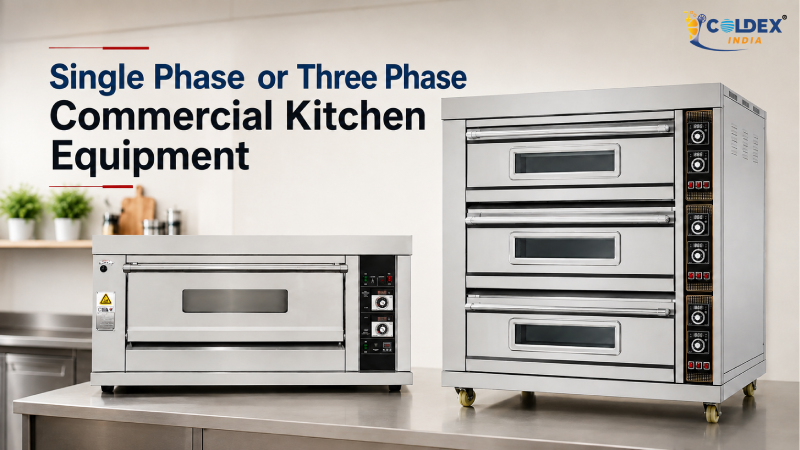
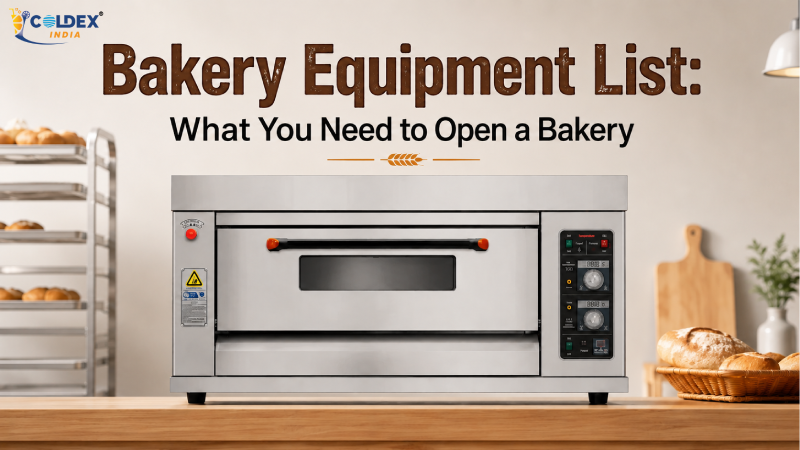
Electric deck ovens run from 3.2 KW for a single deck holding one tray up to 19.6 KW for three decks holding six. They give even, repeatable heat and need no gas line, which suits a rented unit or a mall kitchen. The trade-off is the connected load, and a 19.6 KW oven needs wiring and a sanctioned supply to match.
Gas ovens draw only 100 to 300 W of electricity, because the heat comes from the burner and the power is for the controls. Running cost per bake is usually lower where piped gas or bulk LPG is available, and the same one, two and three deck layouts are offered up to three decks holding nine trays. They need a gas connection and proper ventilation above the oven.
Deck or rotary rack
A deck oven bakes what sits on its stone or tray surface, one shelf at a time, and gives direct control over each deck. That suits a bakery producing several different items through the day. Chamber sizes on the larger models run to 860 x 660 x 200 mm, and it is the chamber you should check your product against, not the oven's outside dimensions.
A rotary rack oven takes a whole trolley of ten 600 x 400 mm trays and turns it through the heat, so every tray colours the same. That matters when one item goes out in volume and colour variation would be visible across the counter. It runs on a gas or diesel burner with a 1.5 KW electrical supply, and stands 1080 x 1400 x 1960 mm, so the doorway and the turning space have to be measured before it is ordered.
Mixers, and why one is not enough
Planetary and spiral mixers look similar and do different jobs. Buying the wrong one is the most expensive mistake in a bakery kitchen, because a planetary mixer asked to knead bread dough all day will not last, and a spiral mixer cannot whip cream at all.
Read the kneading figure, not the bowl
A planetary mixer drives one attachment around a fixed bowl. Change the attachment and it changes job: whisk for cream and egg, paddle for batter and icing, hook for small quantities of dough. The range runs from 7 litres on 350 W to 40 litres on 2 KW.
The number that matters is max kneading, not bowl capacity. A 20 litre planetary takes 20 litres of bowl but is rated for 3 kg of dough. A 40 litre is rated for 12 kg. The bowl figure tells you what fits; the kneading figure tells you what the motor will survive.
A spiral mixer turns a spiral hook one way while the bowl turns the other. That develops gluten without heating the dough, which is what bread needs. The range runs from 10 litres taking 4 kg of dough on 0.75 KW up to 64 litres taking 26 kg on 2.6 KW.
Compare those two figures directly: a 10 litre spiral handles 4 kg of dough while a 20 litre planetary handles 3 kg. If bread, buns or pizza base is your product, a small spiral out-works a much larger planetary and will still be running in five years. Most working bakeries end up with one of each rather than one machine doing both badly.
The counter, and what sells from it
The production side is only half a bakery. What sits between the oven and the customer decides how much of it sells.
Holding and display
A warmer display keeps savoury items hot and, just as importantly, visible. Stainless steel and glass units at 800 W to 1.5 KW hold service temperature without cooking further. Load them hot; a warmer is not designed to reheat. Fried items hold well, anything with gravy will crust at the surface over a long hold, so rotate stock rather than holding one tray all day.
Dessert and add-ons
These are the items that lift an average sale, and each one is a small machine on an ordinary socket.
- Waffle machines at 1.2 to 1.5 KW. Belgian moulds are deep-pocketed and hold ice cream and sauce; lolly waffles come on a stick and suit a walk-away counter; multi-slice machines suit volume and plating.
- Chocolate warmers taking two or three GN pans on 1 to 1.5 KW. Separate pans matter more than capacity, because dark, milk and white should not share one.
- Toasters if you serve anything toasted to order. A conveyor keeps a queue moving where a pop-up cannot.
The order to buy in
Oven first, sized on trays. Then the mixer that matches your main product, sized on kilos. Then holding and display, because product that cannot be seen does not sell. Everything else follows the menu as it settles, and none of it should be bought in the first month on a guess.
One last check that costs nothing and saves a week: confirm the electrical load or the gas line before the machine is dispatched. A three deck oven that arrives before its supply is ready sits in the corner earning nothing.