A machine that arrives before its electrical supply is ready earns nothing, and it is a remarkably common way to lose a week. The fix costs nothing: work out what each machine draws, add it up honestly, and compare it against the supply the premises actually has, before anything is ordered.
This is not an electrician's guide and it does not replace one. It is the arithmetic a buyer should do first, so the conversation with the electrician starts from real numbers.
What each kind of machine draws
The figures below are the ratings on the equipment itself. Reading them in groups is more useful than reading them one by one, because it shows where the load actually sits.
Light: an ordinary socket is enough
Most counter-top equipment falls here, and it is why this class of machine works in rented shop units and food courts with no electrical work at all.
- Chocolate fountains at 170 to 230 W, and chocolate warmers at 1 to 1.5 KW.
- A counter-top bullet ice maker at 120 W, and even the 45 kg undercounter machine at only 600 W.
- Food warmer displays at 800 W to 1.5 KW.
- Toasters: a four slice pop-up at 1.28 KW, a conveyor at 1.3 to 1.92 KW, a vertical bun toaster at 2 KW.
- Gas ovens, which draw only 100 to 300 W. The heat comes from the burner; the electricity is for the controls.
Moderate: check the circuit, not just the socket
These are still single phase machines in most cases, but several on one circuit is a different question from one on its own.
- Sandwich grillers at 2.2 KW for a single plate and 4.5 KW for a double jumbo plate.
- Blenders at 1200 to 2200 W.
- Waffle machines at 1.2 to 1.5 KW.
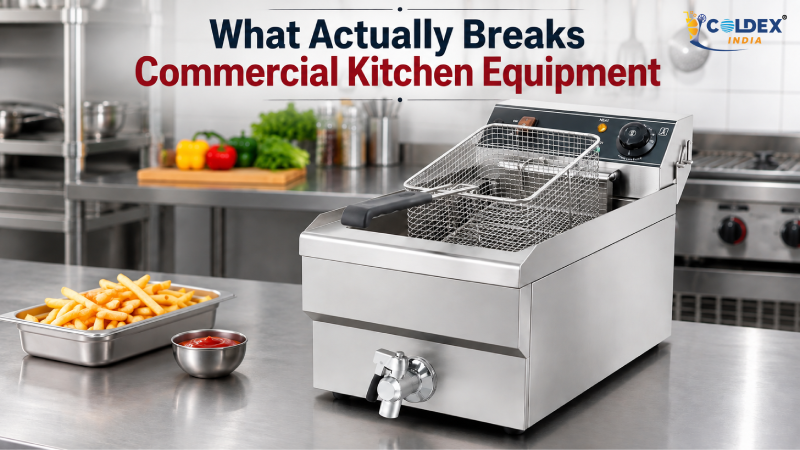
- Counter-top fryers from 2.5 KW at 5.5 litres to 5 KW at 13 litres, and double tank models drawing close to 5 KW and 6.5 KW because each well is heated separately.
- Smaller mixers: a 7 litre planetary at 350 W, a 10 litre spiral at 0.75 KW, rising to 2 KW and 2.6 KW on the largest.
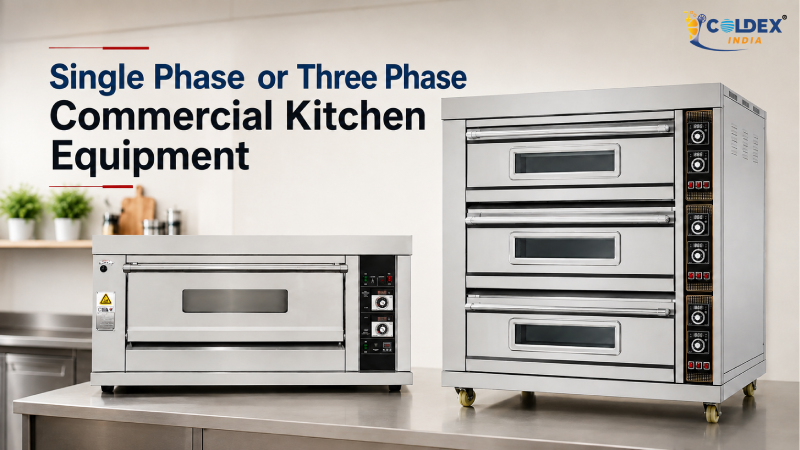
- Single deck electric ovens at 3.2 KW, and single deck pizza ovens from 2 to 3.2 KW.
Heavy: confirm the sanctioned load first
This is the group that catches people out, and every machine in it is worth a conversation before ordering.
- A two deck electric baking oven at 13.2 KW, and a three deck at 19.6 KW.
- A double deck electric pizza oven at 6.4 KW.
- A standing 28 litre deep fryer at 10 KW.
A single machine drawing 19.6 KW is more than many small commercial premises are sanctioned for in total. That is not a reason to avoid it, it is a reason to find out early.
Working out the connected load
Add up what actually runs together
Connected load is the sum of everything that can be on at once. The honest version is not the sum of every machine you own, because a waffle iron used at four in the afternoon and a griller used at one o'clock never peak together. It is also not the load of the largest machine on its own, which is the mistake in the other direction.
Work through a real service hour. List what is switched on during your busiest sixty minutes, add the ratings, and that is the number to take to an electrician. Then add the machine you are about to buy and see what happens to it.
A worked example
A small bakery counter running at peak might have a single deck electric oven at 3.2 KW, a 20 litre planetary mixer at 1.1 KW, a warmer display at 1.5 KW and a four slice toaster at 1.28 KW. That is about 7.1 KW of kitchen equipment before lighting, refrigeration or air conditioning, all of it on ordinary single phase.
Swap that single deck oven for a three deck at 19.6 KW and the same counter is suddenly asking for roughly 23.5 KW. Nothing else changed. One machine moved the premises into a different supply conversation entirely, which is exactly why the oven decision and the electrical decision have to be made together.
Where gas changes the arithmetic
A gas oven takes the largest single load off the electrical supply completely. The same one, two and three deck layouts are available on gas, drawing 100 to 300 W instead of 3.2 to 19.6 KW, because the burner does the heating. Where piped gas or bulk LPG is available that is often the difference between a straightforward fit-out and an expensive supply upgrade, and running cost per bake is usually lower as well.
It is not free: a gas installation needs its own connection, and proper ventilation above the oven. But when the electrical supply is the binding constraint, it is the first thing worth pricing.
Three checks before you order
Confirm the sanctioned load, not the wiring. Premises wiring can be upgraded in an afternoon. A sanctioned supply is an application, and it takes as long as it takes.
Check the plug as well as the load. A 4.5 KW griller and a 1.28 KW toaster both plug in, but they do not belong on the same circuit if it was wired for lighting. This is the most common cause of a breaker that trips at exactly the busiest moment.
Ask what the rating actually means. Where a listing states a supply as 220 V single phase, that is the machine as it ships. Where only a KW figure is given on a large machine, confirm the phase before ordering rather than assuming, because a three phase machine delivered to a single phase site cannot be made to work with an adapter.